Walking the Streets Safely: Awareness Without Fear
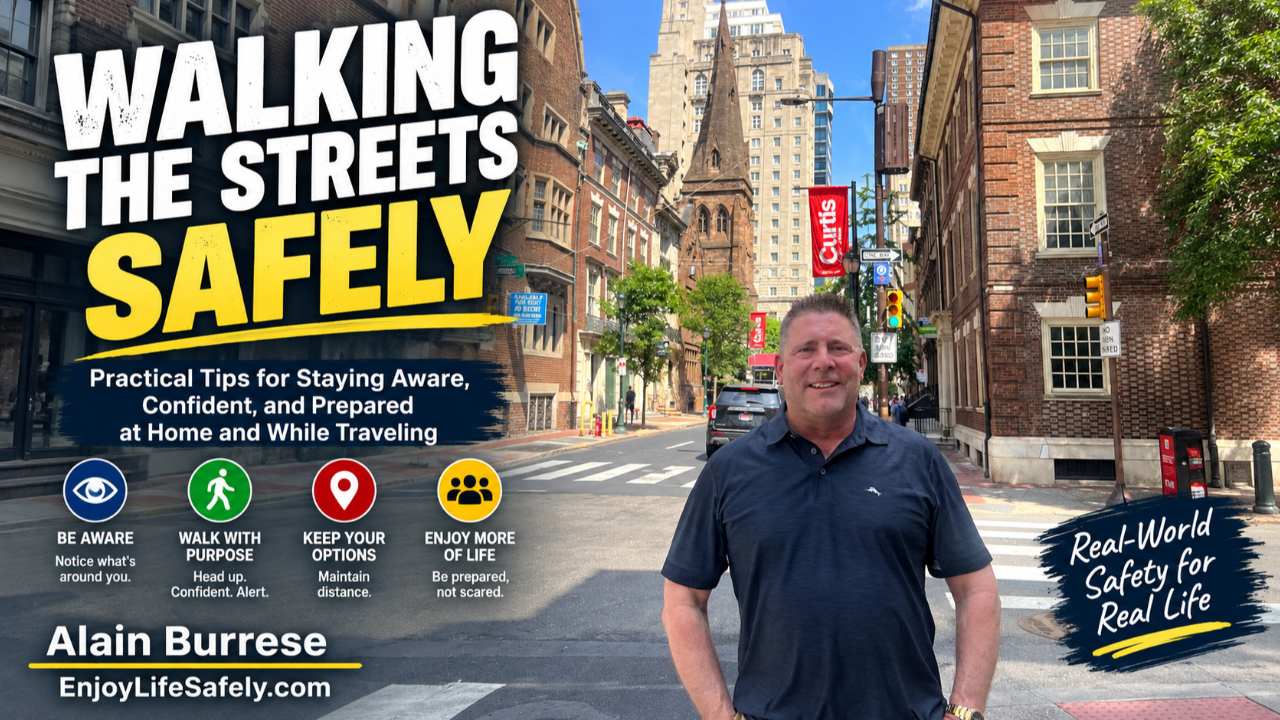
Recently, I was going through some older safety books on my shelves and pulled out The Safety Minute:01 by Robert L. Siciliano. One section focused on personal safety while walking the streets.
Some of the advice reflects the time when the book was written. Technology has changed. The way we navigate cities has changed. Some of our understanding and language surrounding personal safety has changed too.
But reading that section reminded me how many of the fundamental principles of street safety remain the same.
It inspired me to write an article on walking the streets safely for my Enjoy Life Safely newsletter. As I wrote it, I realized there was much more I wanted to say about the subject.
So I decided to expand on it here.
Over the years, I’ve walked the streets of cities around the world. Seoul. Tokyo. Bangkok. Hong Kong. New York. Philadelphia. Los Angeles. Chicago. Washington, D.C., and many others.
I’ve walked unfamiliar streets during the day and at night. I’ve explored cities for work and for fun. I’ve traveled alone and with others.
And I enjoy it.
That's an important point because personal safety shouldn't be about convincing yourself that danger is everywhere.
The purpose of developing good safety habits is exactly the opposite.
Be prepared, not scared.
Learn to recognize potential problems early, make good decisions, and then get out there and enjoy your life.
Walk With Purpose
One of the points Siciliano makes in his book is the importance of walking confidently and purposefully. That's advice I still agree with.
Keep your head up. Look around. Know where you're going whenever possible. Move with purpose.
That doesn't mean puffing out your chest, glaring at strangers, or trying to look tough.
In fact, looking confrontational can create problems rather than prevent them.
There is an important difference between confidence and confrontation.
You simply want your body language to communicate that you're alert, comfortable in your surroundings, and paying attention.
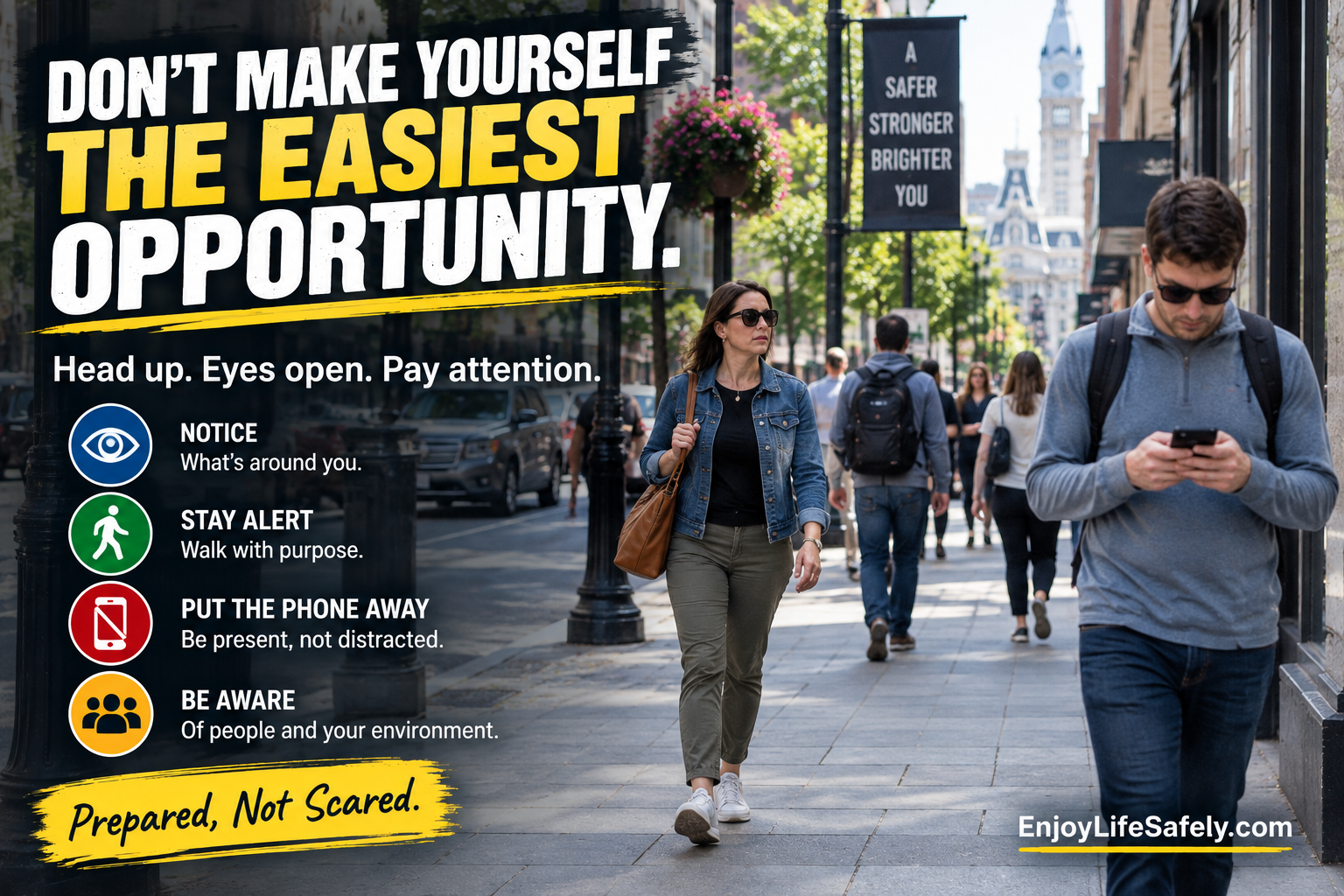
Someone looking for an easy opportunity may notice the person staring at a phone, wandering aimlessly, or completely oblivious to everyone around them.
Don't make yourself the easiest opportunity.
Get Your Eyes Off Your Phone
This is one area where street safety has changed considerably since older safety books were written.
We now carry incredibly useful little computers everywhere we go.
Your phone can help you navigate an unfamiliar city, call for assistance, communicate with friends and family, request a rideshare, translate a language, locate businesses, and find your way back to your hotel.
That's fantastic.
But the same device can also consume your attention.
You've probably seen someone walking down a crowded sidewalk while staring at a screen and paying virtually no attention to anything around them.
Maybe you've done it yourself.
I know I have caught myself paying too much attention to directions on my phone when walking somewhere unfamiliar.
Use your phone as a tool, not a blindfold.
If you're following directions, periodically check your route and then get your eyes back up. Notice people, traffic, entrances, exits, and what's happening around you.
And think about your headphones or earbuds as well. Music, podcasts, and audiobooks are great, but completely shutting off your ability to hear what's happening around you removes one of your senses from your awareness.
Establish a Baseline
One of the awareness concepts I teach is understanding baselines and anomalies.
A baseline is simply what's normal for the environment you're in.
Think about a busy downtown sidewalk at lunchtime. People are walking quickly. Some are talking. Others are entering stores or restaurants. Cars are moving through intersections. Delivery drivers are making stops.
That's the baseline.
You don't need to consciously catalog everything happening around you.
Instead, start noticing what doesn't fit.
That's the anomaly.
Maybe someone is standing still while watching people rather than going anywhere.
Maybe someone changes direction when you do.
Maybe someone repeatedly appears near you.
Maybe someone is approaching you in a way that doesn't make sense.
Maybe a person is trying to close distance when there's plenty of room around you.
None of those things automatically means you're in danger.
But they may be worth noticing.
Don't Judge People. Observe Behavior.
This distinction is important.
Good awareness isn't about deciding that someone looks dangerous because of their clothing, age, race, economic status, or appearance.
Pay attention to behavior.
What is the person doing?
Where are they positioned?
Are they paying unusual attention to you?
Are they trying to distract you?
Are they attempting to isolate you?
Are they deliberately closing distance?
Are they ignoring boundaries?
Behavior gives you useful information.
Appearance often doesn't.
Distance Is Your Friend
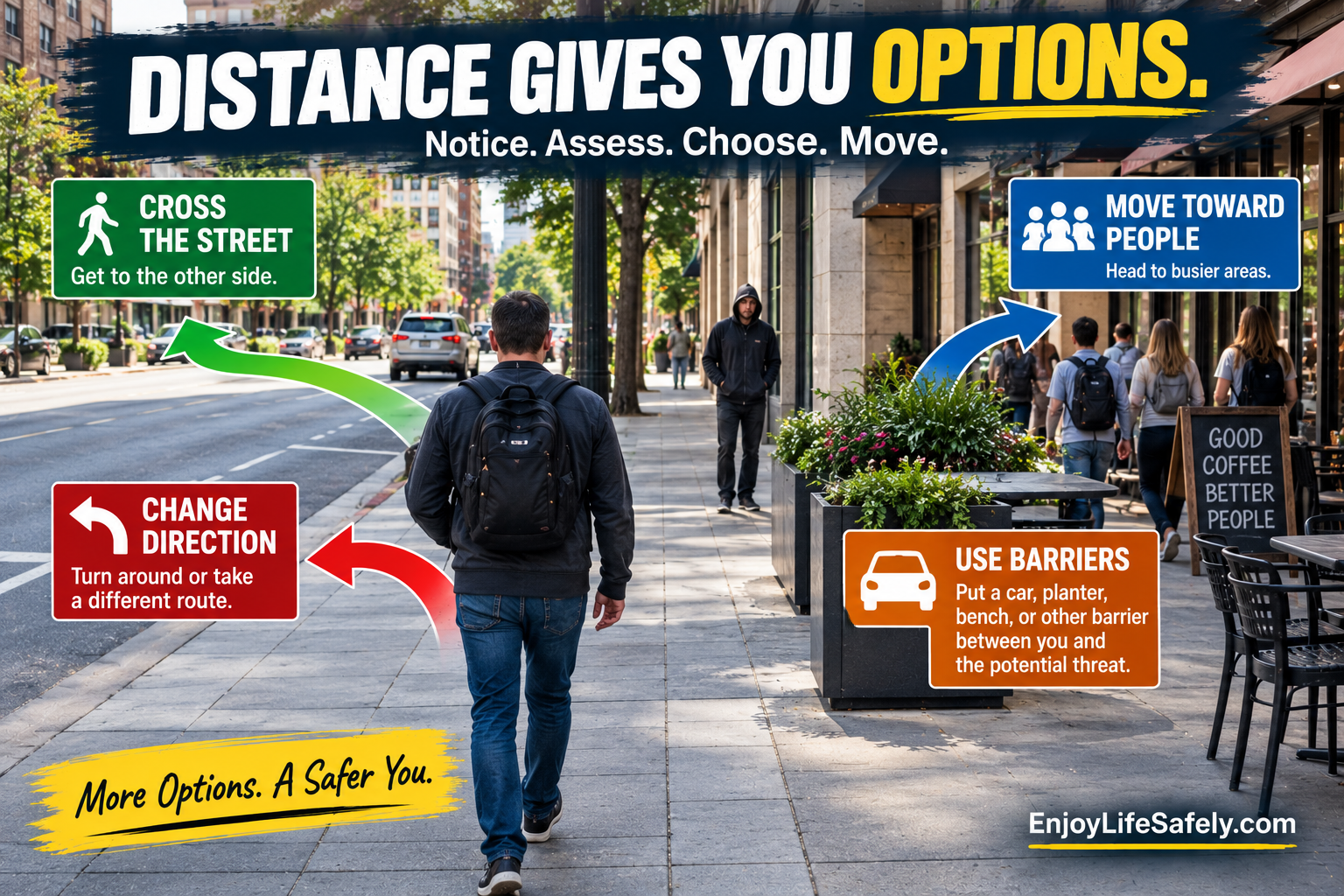
I teach the importance of time, distance, and barriers because they give you options.
If someone makes you uncomfortable, create distance before you know whether that person actually intends to harm you.
Cross the street.
Change direction.
Move toward other people.
Step inside a business.
Position a vehicle, bench, table, counter, or other obstacle between you and the person.
You don't need proof that someone intends to attack you before taking a simple precaution.
This is something people sometimes get backward.
They think:
"I don't want to overreact."
But crossing a street isn't a major reaction.
Walking into a store isn't a major reaction.
Changing direction isn't a major reaction.
If you were wrong, very little was lost.
If you were right, you may have prevented the situation from developing further.
The earlier you recognize a potential problem, the more options you usually have.
Pay Attention in Transitional Spaces
Certain locations deserve a little extra awareness.
Parking lots and garages. Building entrances. Stairwells. Elevators. Public transportation stops. Gas stations. Hotel hallways. ATM areas.
These are sometimes called transitional spaces because you're moving from one environment or activity into another.
They're also places where people often become distracted.
You're searching for your keys.
Loading purchases into the car.
Looking for your hotel room number.
Checking the train schedule.
Unlocking a door.
Getting into a vehicle.
Before entering one of these spaces, take a quick look around.
Who is nearby?
What's happening?
Is anything unusual?
That two-second check can become a valuable habit.
Have Your Keys Ready
Another simple principle from Siciliano's book remains useful today: don't stand beside your vehicle fumbling around looking for your keys.
Technology has made this easier with keyless entry, but the larger principle remains.
Prepare before you arrive at the transition point.
Know where your keys are.
Know which direction you're going.
Have what you need accessible.
The less time you spend distracted while standing beside a vehicle or doorway, the better.
If You Think Someone Is Following You, Test It
Suppose you notice someone behind you.
Don't immediately decide you're being followed.
But don't ignore your concern either.
Change something.
Cross the street.
Turn a corner.
Change your pace.
Enter a populated business.
If the person makes the same changes, you've gained more information.
If your concern increases, don't lead that person to your home, vehicle, hotel room, or another isolated location.
Move toward people and assistance.
Ask store employees, security personnel, or law enforcement for help when appropriate.
There is nothing embarrassing about asking for assistance when you believe something is wrong.
Don't Let Politeness Override Safety
Most of us were raised to be polite.
That's generally a good thing.
But sometimes people exploit our desire not to appear rude.
You don't have to answer every stranger who approaches you.
You don't have to stop because someone asks for directions.
You don't have to let someone move into your personal space because stepping away might seem unfriendly.
You don't have to get into an elevator because someone else is waiting.
And you don't have to explain why you're leaving.
If something doesn't feel right, move.
Your safety matters more than a stranger's opinion of your manners.
Set Clear Boundaries
If someone continues approaching after you've tried to create distance, your communication may need to become more direct.
A strong:
"No."
"Stop."
"Stay back."
can communicate a very clear boundary.
Your voice is one of your defensive tools.
You don't necessarily need to scream at the first sign of discomfort. But if someone ignores your boundaries, you can increase your volume and assertiveness.
At that point, attracting attention may be exactly what you want.
Watch for Distraction and Teamwork
Not every street crime involves one person approaching you directly.
Sometimes one person creates the distraction while another takes advantage of it.
Someone bumps into you.
Someone spills something.
Someone asks an unusually complicated question.
Someone creates a commotion.
Again, none of these things automatically means criminal intent.
Help people when you reasonably can. Be friendly. Enjoy interacting with others.
Just don't allow one unexpected event to consume all of your attention.
When something unusual happens, maintain awareness of the larger environment.
Protect Your Personal Information Too
Modern street safety isn't only physical.
Suppose you're using your phone in public. Can someone see your unlock code?
Are you discussing your hotel room number where strangers can hear it?
Are luggage tags or documents displaying information you don't need to expose?
Are you posting your exact location publicly while you're still there?
Our phones and digital lives have created personal-security considerations that barely existed when many older safety books were written.
Awareness now includes protecting information as well as protecting physical space.
Trust Your Intuition, Then Verify
People sometimes say, "Trust your gut."
I agree, with an important addition.
Trust your intuition enough to investigate it.
You don't need to automatically conclude that something bad is happening.
But don't ignore that little warning either.
Maybe you've unconsciously noticed something that doesn't fit.
Look around.
Create distance.
Change your position.
Gather more information.
Sometimes you'll discover there was nothing to worry about.
Great.
That's a good outcome.
If Avoidance Fails, Act
The goal is always to recognize and avoid trouble whenever possible.
But sometimes avoidance doesn't work.
If someone actually attacks you, circumstances change quickly.
Your priorities become creating an opportunity to escape, attracting attention when appropriate, defending yourself if necessary, and getting to safety.
This is why I teach personal safety as much more than physical self-defense.
The punch, kick, escape, defensive spray, or other physical response is only one piece of a much larger picture.
That doesn’t mean physical self-defense skills aren’t important. I believe they are, which is why I’ve spent decades learning and teaching them, and why I created my Self-Defense Essentials course. I regularly write about and teach physical self-defense because having those skills gives you additional options when avoidance fails. They just aren’t all there is to personal safety.
The best outcome is usually the one where you recognize the developing problem early enough that you never need those physical skills.
Don't Become So Safety Conscious That You Stop Living
This may be the most important part of this entire article.
I don't walk through Seoul, Tokyo, Bangkok, Hong Kong, New York, Philadelphia, or anywhere else assuming everyone around me might attack me.
What kind of life would that be?
I notice people.
I enjoy the architecture.
I look for interesting restaurants.
I talk to people.
I explore.
I take pictures.
I experience the city.
And somewhere in the background, I'm also paying attention.
That's what good awareness eventually becomes.
It isn't paranoia.
It's a habit.
The purpose of personal safety is not to eliminate every possible risk from your life. That's impossible.
It's to develop habits that reduce unnecessary risks while allowing you to experience more of what life has to offer.
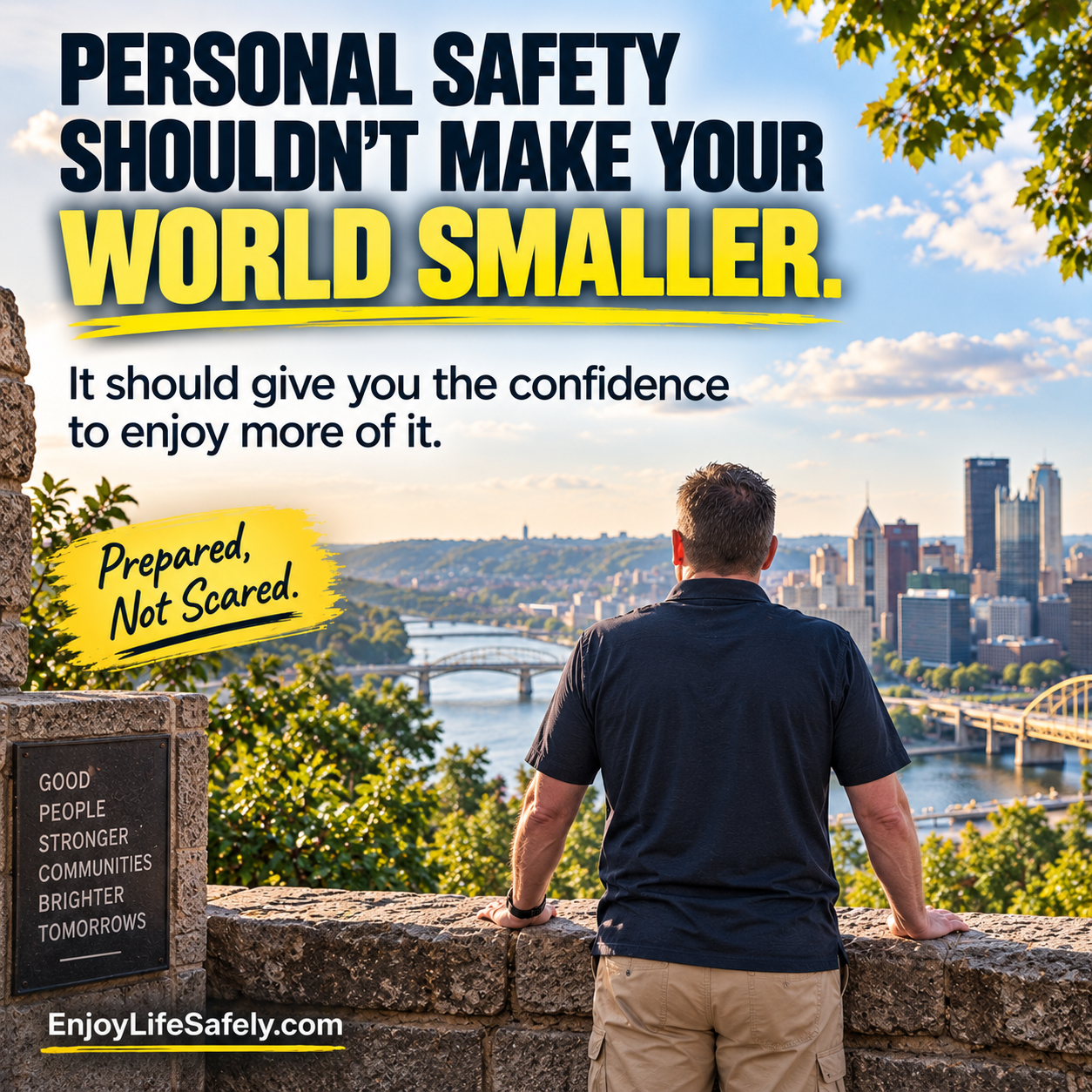
So wherever your next walk takes you, keep your head up. Notice what's happening around you. Walk with purpose. Maintain your options. Set boundaries when necessary. Trust your intuition enough to investigate it. And act early when something doesn't seem right.
Then keep walking.
There's a lot of world out there worth seeing.
Be Aware. Be Prepared. Be Safe.