The Value of Forms After a Lifetime of Training

I have spent most of my life studying martial arts. I trained in South Korea, served as an Army paratrooper and sniper, and have spent decades teaching practical self-defense. Because of that background, some people may be surprised to learn that I still practice and teach forms.
Every so often, I see someone declare that forms are useless because they do not look like a real fight.
I understand where that opinion comes from.
If someone came to me and said, “I need to learn how to defend myself as quickly as possible,” I would not begin by teaching that person forms. We would spend our limited training time on awareness, avoidance, de-escalation, positioning, simple and effective physical skills, and realistic practice under pressure.
If your only goal is to learn how to fight in the shortest amount of time, practicing forms is probably not the most productive use of your time.
But that is not the whole story.
Martial arts can include practical fighting skills, personal development, physical conditioning, history, culture, tradition, and the preservation of an art. When we look at the development of a complete martial artist rather than simply the fastest way to teach someone to fight, forms can have an important place.
Forms at My Hapkido School in Korea
When I lived and trained in South Korea, forms were a regular part of our Hapkido classes.
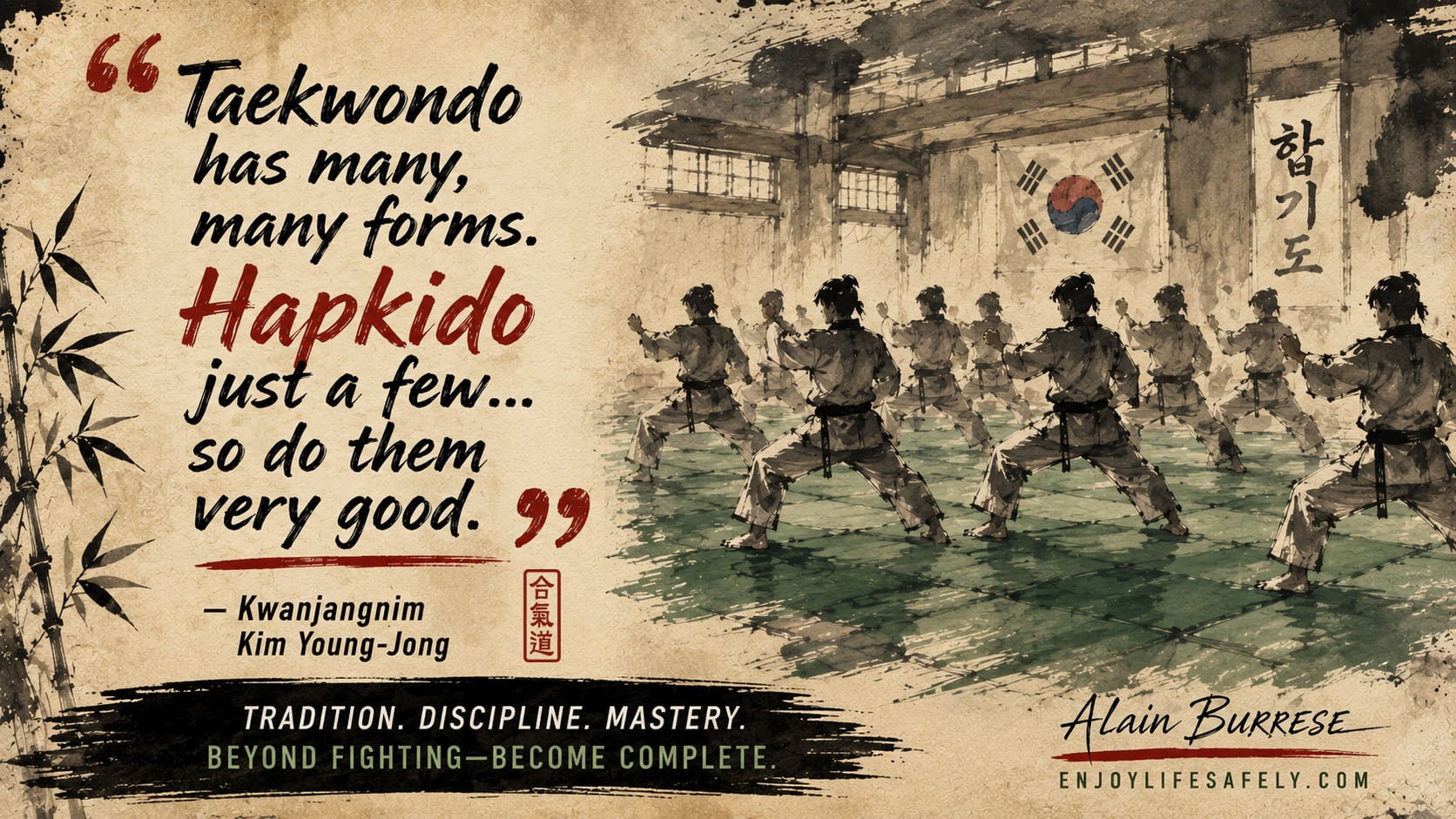
Kwanjangnim Kim Young-Jong led the school, although Sabumn Lee Jun-kyu taught most of the day-to-day classes. Every once in a while, Kwanjangnim would teach or share a lesson with us.
During one of those times, he made a comment that has stayed with me for all these years:
“Taekwondo has many, many forms. Hapkido just a few, so do them very good.”
Forms were not the entire focus of our training. They were simply one part of the class.
We began with different warm-up exercises and then practiced forms together. The entire group worked on the green padded floor that covered the dojang. We needed that padding because falling, rolling, and throwing were such important parts of our Hapkido training.
Students of different ranks worked on the form appropriate for their level. Those who were still learning a form practiced the sequence and added new movements when they were ready. Those who already knew the form for their belt continued practicing it with the goal of making it better.
The instructor might correct a hand position, balance, posture, timing, or transition. Knowing the sequence was only the beginning. The goal was to perform each movement with greater precision, control, and purpose.
Then we moved on to the other parts of class.
I remember standing on those green mats through the heat of the Korean summers and the cold of the winters. Regardless of the season, we showed up, practiced the same movements, received corrections, and tried to improve.
The Influence Behind the Forms
Many Hapkido organizations do not practice forms at all. That is not necessarily wrong. Hapkido has always placed a strong emphasis on practical application, including strikes, kicks, joint locks, throws, falls, and self-defense techniques.
Our school was a little different.
In addition to Hapkido, Kwanjangnim Kim had trained in Wushu and Qigong. You could see some of that influence in the forms he taught. The movements often emphasized fluidity, breathing, balance, coordination, and body control.
Those forms became part of the Hapkido that was passed down to me.
I have continued to practice and teach them, even though I understand that many other Hapkido practitioners have never practiced forms and may see no reason to begin.
My decision to continue them is not based on the belief that forms alone prepare someone for a real confrontation. They do not.
Forms are one training method. Sparring is another. Pad work, partner drills, throwing practice, pressure testing, scenario training, and physical conditioning all serve different purposes.
The mistake is expecting one training method to do everything.
What Forms Can Develop
Forms will not automatically make someone a capable fighter. A person cannot practice movements alone in the air and assume that this will fully prepare them for the unpredictability, fear, resistance, and violence of a real attack.
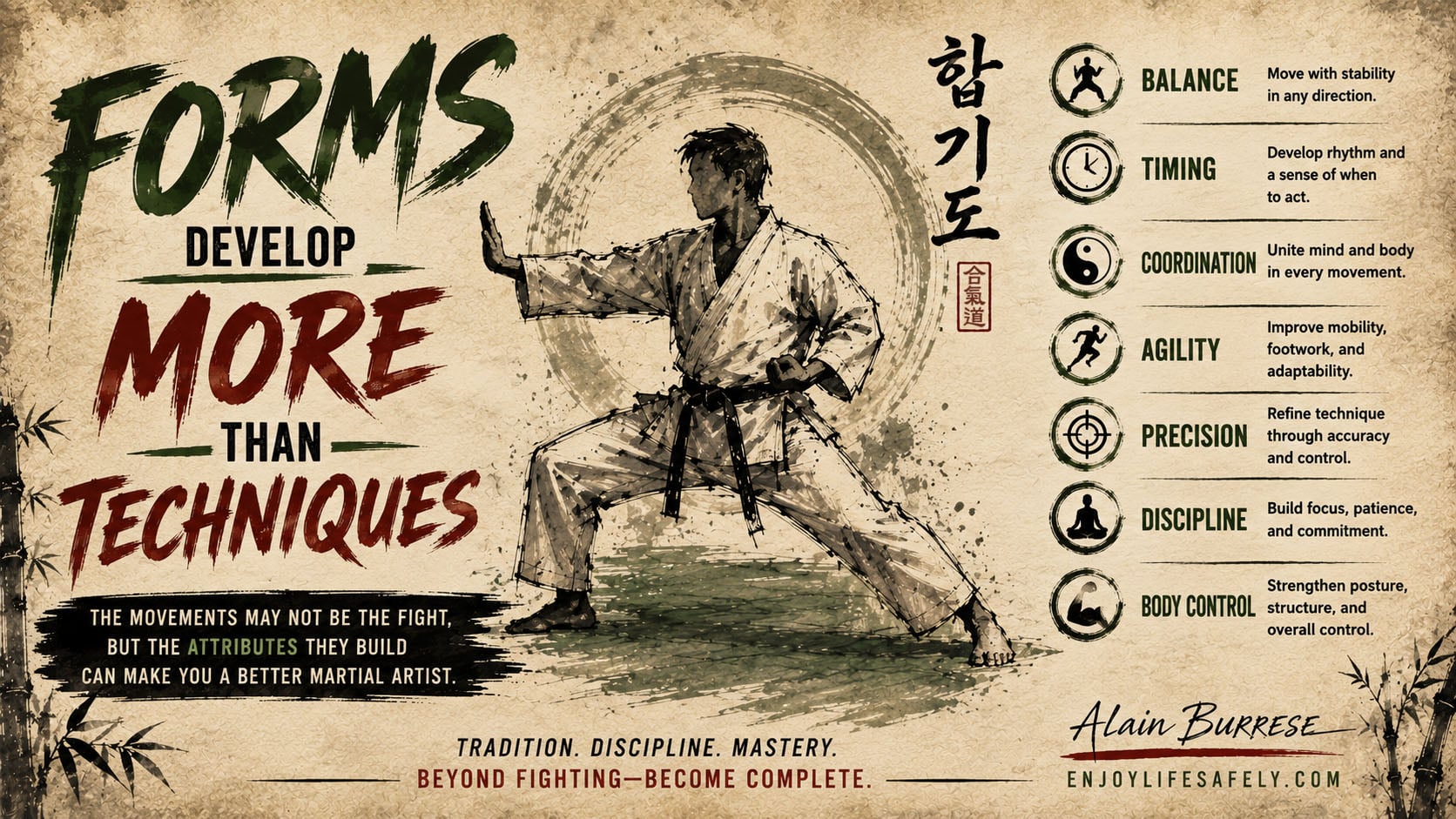
However, forms can help develop physical and mental qualities that support martial arts training.
They can improve balance while moving and changing direction. They develop coordination between the upper and lower body. They can strengthen posture, agility, timing, rhythm, breathing, and body awareness.
Forms also provide an opportunity to work on transitions. A martial artist learns to move from one position to another smoothly rather than treating every technique as an isolated movement.
Repeated practice can improve precision, focus, discipline, and control. It can also enhance overall athleticism.
None of these qualities replace realistic fighting or self-defense practice. But all of them can contribute to making someone a better mover, a better athlete, and a more complete martial artist.
Forms Are Not Fighting
One mistake is treating forms as though they are the same as fighting.
They are not.
Real confrontations are chaotic. Attackers do not move in a cooperative sequence. They do not pause while you complete a movement, and they do not respond exactly as imagined. Fighting ability requires training against resistance, unpredictability, pressure, and contact.
But the opposite extreme also misses the point.
Dismissing every form as worthless because it is not a fight is like dismissing strength training because lifting weights does not look like a fight. Different methods develop different attributes.
A complete training program should be honest about what each method can and cannot accomplish.
Train realistically when the goal is fighting or self-defense. Work with partners. Hit pads and bags. Practice timing, distance, movement, resistance, and decision-making under pressure.
Practice forms for the qualities they can develop and for the history they preserve.
There is no need to pretend they are the same thing.
Honoring the People Who Taught Me
There is another reason I continue practicing and teaching these forms.
They connect me to my time living and training in Korea.
When I perform them, I remember the instructors who invested their time and knowledge in me. I remember my training partners, the green padded floor, the summer heat, the winter cold, and the repetition required to make each movement a little better.
My instructors gave me more than a collection of techniques. They shared part of their culture, their experience, and their approach to martial arts.
Continuing to practice the forms they taught me is one way I honor them.
Martial arts are passed from one generation to the next because someone decides the lessons are worth preserving. If every student keeps only the parts that offer the quickest practical result, some of the art will eventually disappear.
That does not mean everything old must be preserved without question. Traditions should be examined honestly. Training methods should be understood, and unrealistic claims should be challenged.
But traditions that still provide value deserve consideration.
Tradition and Practicality Can Coexist
I do not practice forms because I believe they are the fastest way to become a fighter.
I practice them because they help develop balance, coordination, timing, agility, discipline, and body control. I practice them because they are part of the Hapkido that was taught to me. And I practice them because they remind me of the instructors and experiences that helped shape the martial artist I became.
Fighting skills matter.
Realistic self-defense training matters.
Pressure testing matters.
But preserving valuable parts of an art matters too.
We do not have to choose between tradition and practicality. We can train honestly for the realities of violence while still respecting the history and culture of the martial arts.
Forms are not fighting.
But when they are understood and practiced for the right reasons, they still have value.
And as Kwanjangnim Kim reminded us, if your art has only a few forms, do them very well.