How to Tell Where Gunfire Is Coming From
After the active shooter event at the In-N-Out in Twin Falls, Idaho, I’ve had several conversations about active shooter response training.
I’m currently in discussions with a couple of organizations here in Montana and another in Maine about providing training. Events like Twin Falls have a way of reminding people that these attacks can happen almost anywhere. They also remind organizations of the importance of preparing their people before something happens.
Because of the Twin Falls attack and these recent training inquiries, I wanted to address a topic I’ve previously covered in my newsletter but haven’t written about here on the blog:
How do you tell where gunfire is coming from?
It sounds like a simple question.
It isn’t always.
Gunfire Can Be Difficult to Locate
If you hear gunshots outside in an open area, you may be able to determine their general direction fairly quickly. But inside a building, things can become much more confusing.
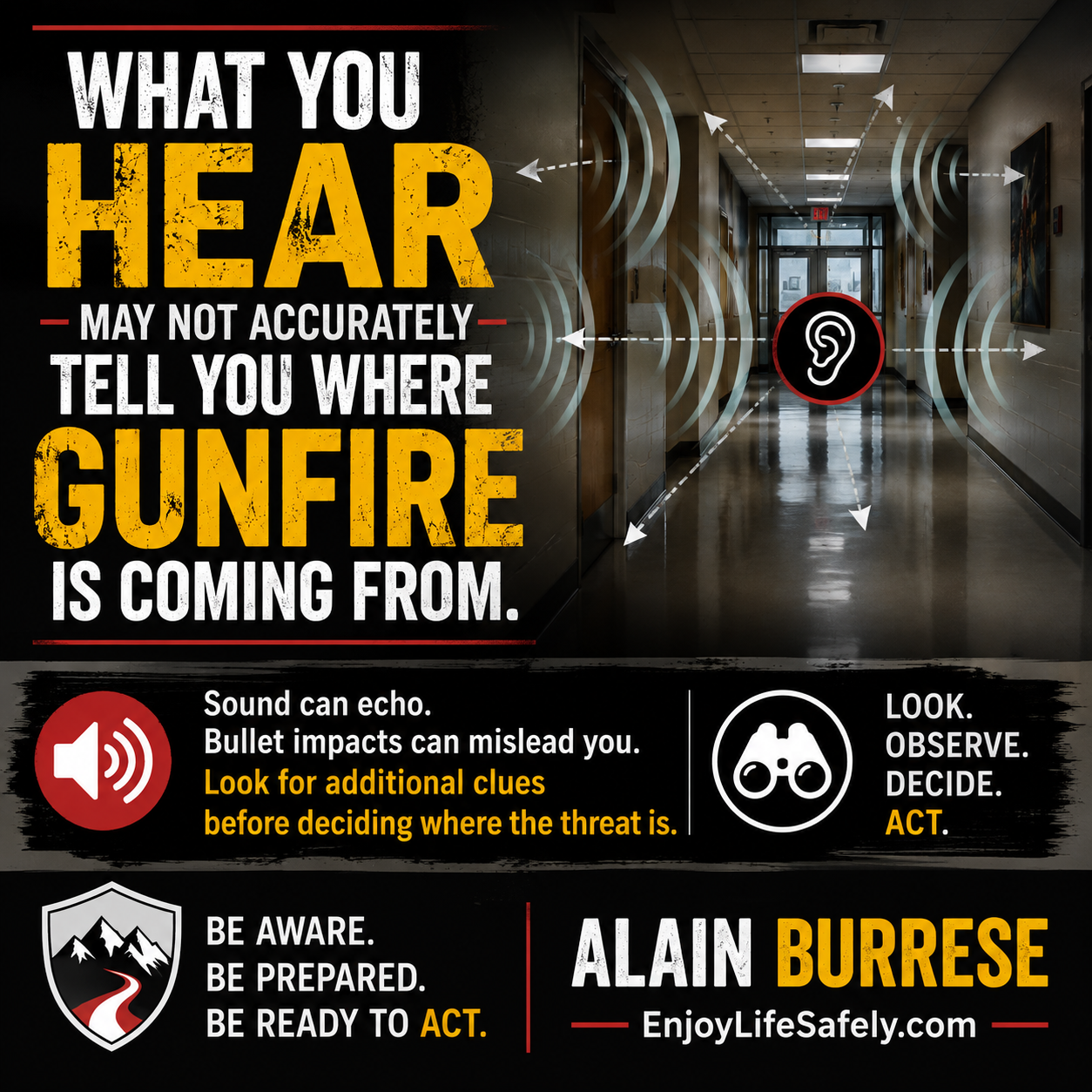
Walls, hallways, doors, windows, stairwells, and other hard surfaces can cause sound to echo and bounce in different directions. What sounds like gunfire coming from one direction may actually be coming from somewhere else.
I’ve seen this happen firsthand during training.
When I was part of the Safariland team teaching Active Shooter Response classes, we conducted scenarios inside buildings using blanks to provide realistic gunfire sounds.
Time and time again, I watched students misjudge where the shots were coming from.
In some scenarios, people actually moved toward the shooter because the echoes made it sound as though the shots were coming from the opposite end of the hallway.
That is an important lesson.
Do not automatically assume that the direction you hear the gunfire is the direction it is actually coming from.
Sound Can Be Deceptive
There is another problem.
During a real shooting, you may not only be hearing the firearm itself.
You could be hearing bullets striking walls, doors, windows, furniture, or other objects. There may also be screaming, alarms, breaking glass, people running, and countless other sounds competing for your attention.
Your brain is suddenly being asked to process an enormous amount of information while you're under extreme stress.
That makes determining the shooter's location even more difficult.
This doesn't mean you should ignore what you hear. Sound is valuable information. You simply shouldn't rely on it as your only source of information.
Look at What Other People Are Doing
If you can't determine where the gunfire is coming from, pay attention to what is happening around you.
Are people suddenly running from one particular area?
Are people coming through a doorway yelling that someone has a gun?
Can you see people reacting to something farther down a hallway?
Those observations may help you determine where the danger is located.
But again, don't blindly follow a crowd.
People panic. People make mistakes. And they may not know any more about what is happening than you do.
Instead, gather as much information as you can while making your own decisions.
Look for the Muzzle Flash
One of the most useful visual indicators of the shooter's actual location is muzzle flash.
Sound can echo.
The noise of bullet impacts can be mistaken for the sound of the gun itself.
But if you can actually see the flash coming from a firearm as it is being fired, you have a much stronger indication of where the shooter is located.
That information can help you determine which direction to move.
If you identify the shooter's location and you have a safe escape route leading away from the threat, move away from the shooter and get out.
Don't remain in place trying to gather more information than you need. Your goal isn't to investigate what is happening.
Your goal is to survive.
You Must ACT
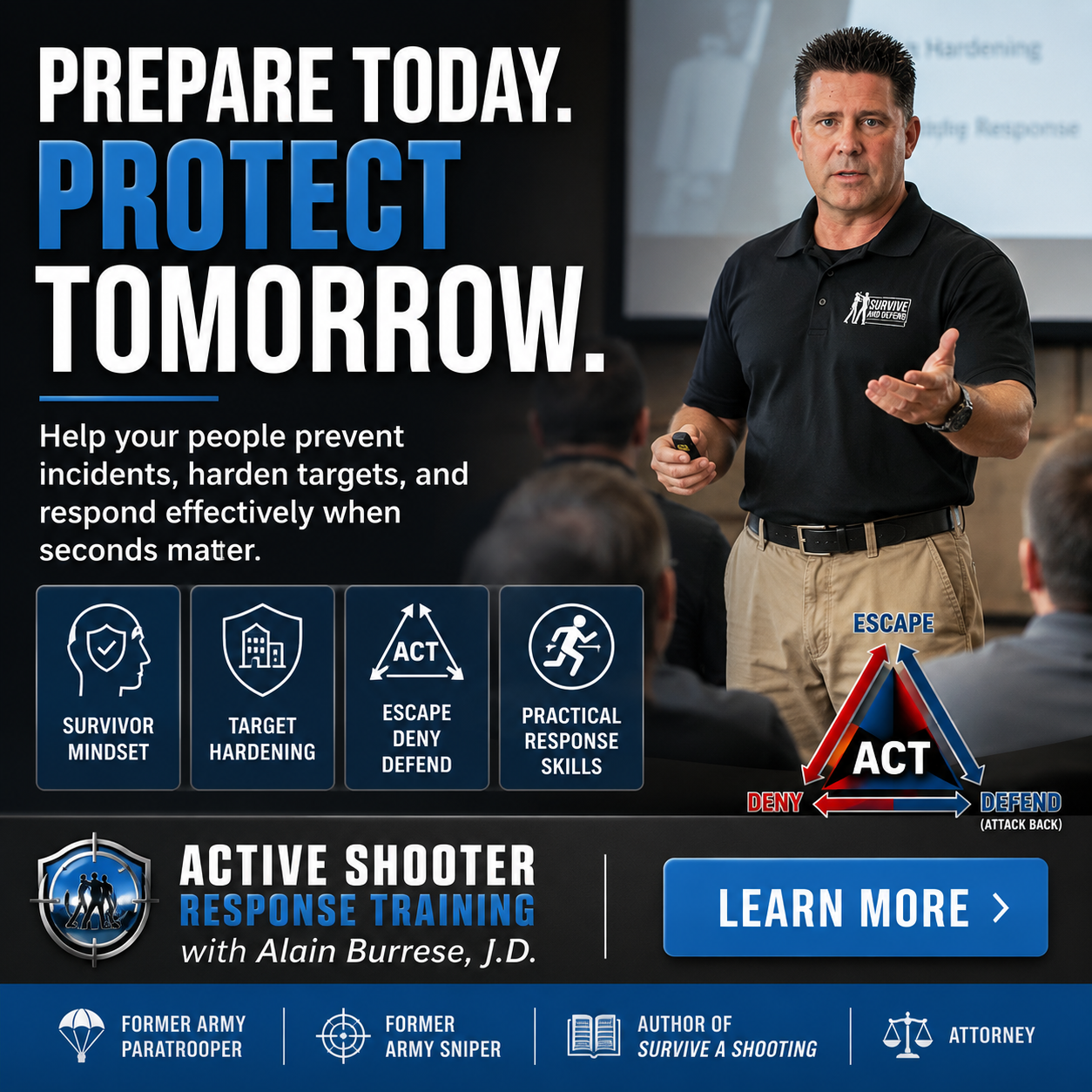
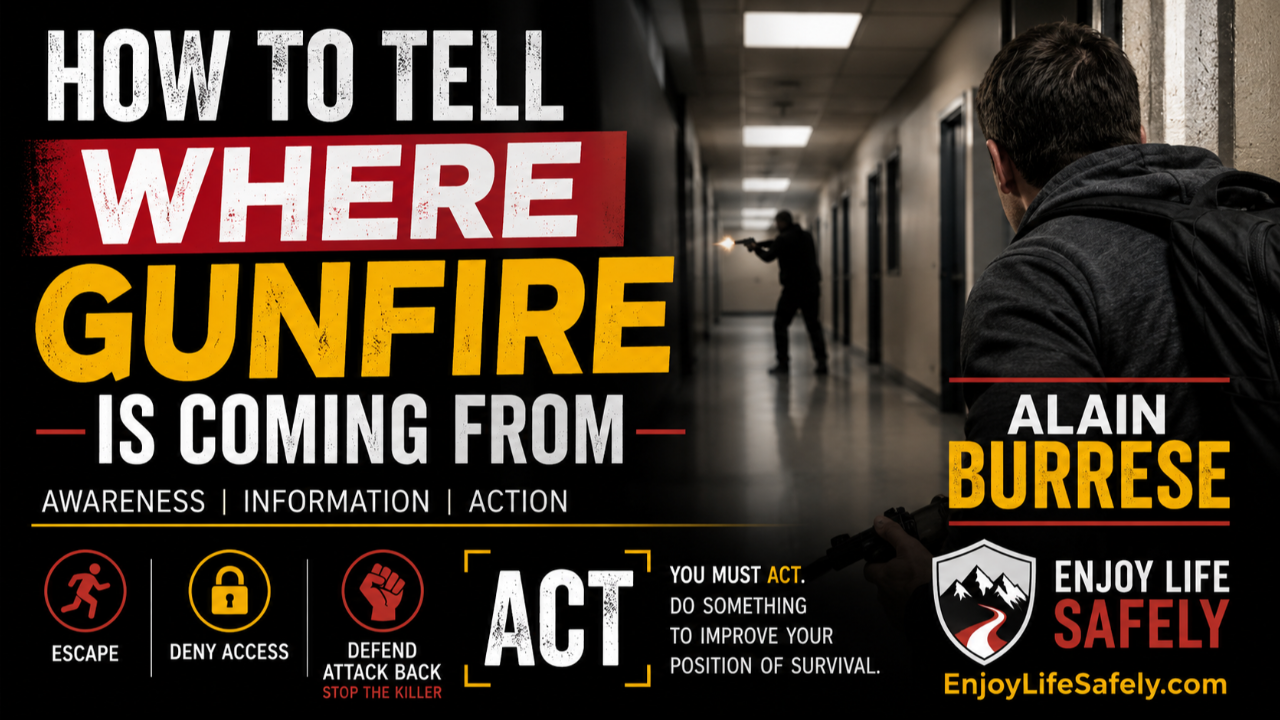
The response model I teach is Escape–Deny–Defend, with ACT at the center.
ACT is there for a reason.
When faced with an active killer, you must act. You must do something to improve your position of survival.
Standing there doing nothing is not a survival strategy. You need to make a decision and take action.
That action generally falls into one of three categories:
Escape. If you have a safe way out, get away from the danger. Move away from the killer and toward safety. Don't wait for someone to give you permission to leave.
Deny. If you can't safely escape, deny the killer access to you. Lock doors. Barricade entrances. Put obstacles between yourself and the threat. Make it as difficult as possible for the killer to reach you.
Defend. If you cannot escape and you cannot keep the killer from reaching you, you must be prepared to defend yourself. Attack back and stop the killer. Use whatever means are available and commit to your actions.
You don't necessarily get to choose which option you would prefer. The circumstances may make that decision for you.
What matters is that you ACT.
Do something that improves your position of survival.
Escape Requires Information
If escape is available, it is generally your first and best option. But escaping effectively requires information.
Where is the threat?
Where is your nearest safe exit?
Is the route you're considering taking you away from the shooter or potentially toward the shooter?
That's why knowing where gunfire is coming from can be so important.
If you hear what you believe to be gunfire, don't waste precious time convincing yourself that it must be something else. Pay attention. Look around. Gather the information available to you and ACT.
If you can identify where the threat is located, move in the opposite direction toward safety when possible.
Awareness Gives You Options
No article can tell you exactly what you should do during every active shooter event.
Buildings are different. Attacks are different. Your location relative to the attacker will be different. The information available to you will be different.
That's why I don't want people memorizing a rigid checklist and assuming it will work in every situation.
I want people to understand principles that help them make better decisions under pressure.
One of those principles is simple:
What you hear may not accurately tell you where the shooter is.
Listen to the gunfire, but don't depend solely on your ears. Look at what is happening around you. Observe how other people are reacting. Look for visual indicators of the threat, including muzzle flashes when visible.
Then use that information to make the best decision you can.
The sooner you recognize what is happening and determine where the danger is coming from, the sooner you can take action to improve your position of survival.
Escape if you can. Deny access if you can't. And if those options are gone, defend yourself and attack back to stop the killer.
Whatever the circumstances, ACT.
You don't need to live afraid of violence. But you should understand how to respond if violence suddenly finds you.
Be aware. Be prepared. Be ready to ACT.